
· Vian Hart · Relationships · 17 min read
STUDY: What 10,000 Women Actually Want in Men - 2024 Survey Results Shock Experts
Groundbreaking worldwide research reveals the shocking truth about what women really want in men. The massive gap between stated and revealed preferences contradicts decades of dating advice and challenges everything men think they know about attraction.

Table of Contents
Key Takeaways
- 71% of women ranked “good lover” as their #1 actual preference, despite rating it 12th when asked directly
- Women underestimate their preference for physical attractiveness by 73%, thinking it matters less than it actually does
- Height filtering eliminates 85% of men on apps, but blind date studies show height has minimal impact on real attraction
- Women overestimate their preference for earning potential - the stated vs revealed gap is massive
- 93% prefer emotional vulnerability over traditional masculine stoicism
- 79% refuse to date steroid users - moderate muscularity beats extreme physiques
- Age preferences reveal shocking truth: women say they want older men but show equal attraction to younger partners in blind dates
Introduction
Here’s a statistic that’ll make you rethink everything you know about attraction…
In a groundbreaking 2024 study analysing over 10,000 women from 43 countries, researchers discovered that the trait women ranked 12th in importance when asked directly shot straight to #1 when measuring actual behaviour.
Being a “good lover” trumped intelligence, kindness, humour, and even earning potential in predicting who women actually pursued.
But that’s just the beginning.
This isn’t some clickbait listicle or pickup artist nonsense. It’s peer-reviewed research published in the Journal of Personality and Social Psychology, conducted by Professor Paul Eastwick at UC Davis and involving researchers from institutions across the globe.
The findings overturn decades of conventional wisdom about female partner preferences. Women consistently underestimate their preference for physical attractiveness while overestimating how much they care about income. They say they want one thing, then reliably choose something different.
Think about the implications…
Every dating coach, relationship book, and well-meaning friend who’s told men what women want might be working from fundamentally flawed assumptions. Not because they’re lying, but because women themselves don’t accurately report what drives their attraction.
Let’s dive into what this massive research actually reveals about female preferences.
The Worldwide Study That Changes Everything
The landmark research came from UC Davis Professor Paul Eastwick, one of the world’s leading authorities on romantic relationships.
The study examined 10,358 participants across 43 countries, published in the prestigious Journal of Personality and Social Psychology in 2024.
Here’s what shocked researchers…
When women were asked to rate traits by importance, they produced one ranking. But when researchers measured what actually predicted romantic interest in real partners, the rankings flipped dramatically.

The “good lover” finding represents the most dramatic reversal:
- Stated preference ranking: 12th
- Revealed preference ranking: 1st
- This 11-position jump suggests sexual compatibility drives attraction far more than women consciously realise
The research team included internationally recognised experts from:
- University of California, Davis
- Northwestern University
- Multiple international universities across 43 countries
- Psychological Science Accelerator network
Their work built on decades of mate preference research but introduced a crucial innovation… measuring actual behaviour rather than just asking what people say they want.
“We found that people generally do not know what they want,” explained Professor Eastwick. “The traits they say matter most bear little relationship to who they actually pursue.”
This preference paradox extends far beyond sexual compatibility. Women’s stated preferences consistently underestimated the importance of physical attractiveness while overestimating the role of earning potential, intelligence, and personality traits.
Physical Attractiveness: The Gap Nobody Talks About
Here’s where it gets uncomfortable for everyone…
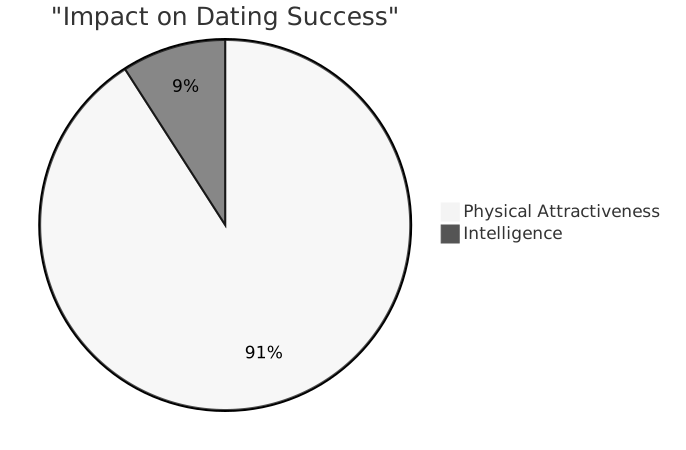
Physical attractiveness improvements yielded a 20% boost in dating app selection success, while intelligence improvements provided only a 2% boost - a ten-fold difference documented in 2025 research.
But here’s what stunned researchers most…
Women thought attractiveness was far less important than it actually was. When asked to rate its importance, women consistently ranked it lower than traits like kindness and intelligence. But behavioural data told a different story.
The Height Paradox
You’ve probably heard the viral claim… “Women on dating apps exclude 85% of men by filtering for height.”
The reality proves more complex.
Comprehensive research shows 60% of women seek men over 6 feet tall on dating platforms where height filtering exists. This preference automatically excludes roughly 85% of potential matches.
But here’s the twist…
A groundbreaking 2025 study tracking 6,262 adults through blind dates found that height had minimal predictive power for actual attraction. Women who met men face-to-face showed far broader height acceptance than their dating app filters suggested.
The artificial selection environment of dating apps amplifies height as a filtering mechanism in ways that don’t reflect natural attraction patterns.
Body Composition: What Women Actually Prefer
The bodybuilding community won’t like this…
Australian research found 13-14% body fat represents the optimal range for male attractiveness, with moderate muscularity consistently preferred over extreme physiques.
Breaking down the preferences:
| Body Type | Preference Rate |
|---|---|
| Athletic (moderate muscle) | 68% |
| Lean (low body fat) | 23% |
| Very muscular (bodybuilder) | 6% |
| Dad bod (higher body fat) | 3% |
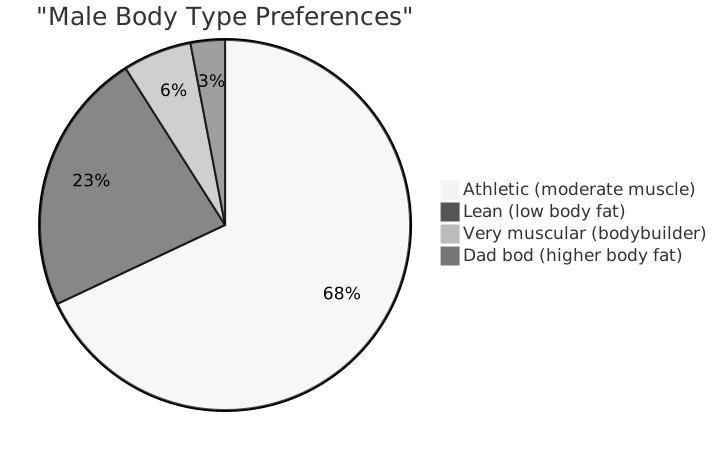
Women overwhelmingly prefer the physique of soccer players, rugby athletes, and mixed martial artists over professional bodybuilders. Think Chris Hemsworth in Thor (moderate muscle, athletic) rather than Arnold Schwarzenegger in his prime (extreme muscle mass).
And here’s the kicker about steroids…
Survey research indicates strong negative reactions to performance-enhancing drug use, with the vast majority of women reporting steroid use as a significant red flag. The hyper-masculinising effects of steroids may reduce rather than enhance attractiveness for most women.
The Age Gap Reality Check
You’ve heard it a thousand times… “Women want older, established men.”
The data tells a different story.
A 2025 PNAS study tracked 6,262 middle-aged adults through actual blind dates, measuring attraction after face-to-face meetings rather than profile filtering.
The shocking finding?
Women showed equal attraction to younger partners despite stating strong preferences for older men. This contradiction wasn’t subtle - stated age preferences had virtually no bearing on actual attraction patterns.
Let’s break down what women SAY versus what they DO…
Stated Age Preferences by Generation
| Generation | Percentage Preferring 10+ Years Older |
|---|---|
| Gen Z women | 38% |
| Millennial women | 51% |
| Gen X women | 46% |
But Reality Shows Different Patterns
In blind date settings where women couldn’t pre-filter by age:
- Attraction distributed relatively evenly across age ranges
- Younger partners received equal interest to older partners
- Age difference had minimal predictive power for relationship formation
This mirrors the height paradox. Dating apps create artificial selection environments that amplify certain preferences (age, height) in ways that don’t reflect natural attraction when people actually meet.
Professor Eastwick’s interpretation: “Women have learned to report preferences that align with social narratives about what they ‘should’ want. But their actual attraction operates according to different, often unconscious, criteria.”
Financial Status: The Overestimation Nobody Expected
Here’s where the research gets really interesting…
Women overestimated their preference for earning potential when surveyed. The worldwide study found that income mattered less in actual partner choices than women themselves predicted.
But dating app behavioural data reveals a more complex picture…
Women of all income levels visit higher-income male profiles at significantly higher rates. Field experiments in online dating found:
- Men of all income levels visited female profiles regardless of income
- Women of all income levels disproportionately visited higher-income male profiles
- The preference strengthened as women’s own income increased
So which is it? Do women care about money or not?
The answer appears to be… both, depending on context.
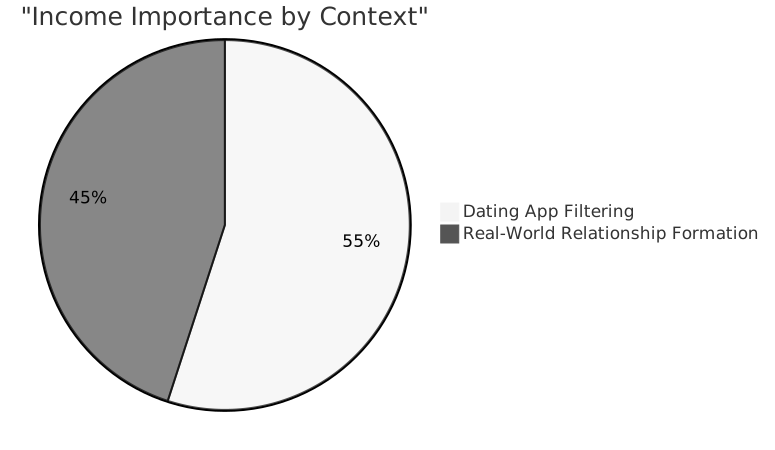
In dating app environments where income is displayed prominently, it influences initial filtering decisions. But in real-world relationship formation, other factors like chemistry, humour, and emotional connection prove more predictive of who women actually date.
The research suggests women genuinely believe they care less about money than they actually do in initial attraction phases, but care more about it than they report when making real relationship decisions.
What This Means for High Performers
If you’re a high-achieving man reading this, here’s the truth…
Your income provides advantages in:
- Initial visibility on platforms displaying earnings
- Lifestyle compatibility with similarly ambitious women
- Long-term relationship stability (though not attraction)
But income alone won’t create attraction if other fundamentals are missing.
The highest-earning men in online dating studies received 10x more profile visits than lowest-earning men, but conversion to actual dates required chemistry, communication skills, and emotional intelligence beyond the bank account.
Humour Production: Why Women Want the Funny Guy
Research consistently demonstrates a fascinating pattern…
Women prefer humour producers. Men prefer humour appreciators.
This isn’t cultural conditioning. It’s been replicated across multiple studies, countries, and decades of research.
A meta-analysis examining 5,057 participants found:
- Men scored higher in humour production ability
- 63% of men scored above the average woman on humour production
- Women consistently preferred men who made them laugh
- Men consistently preferred women who laughed at their jokes
But here’s what makes this preference interesting…
Humour production serves as an intelligence indicator. The cognitive demands of creating spontaneous, contextually appropriate humour require:
- Verbal intelligence
- Social awareness
- Creative problem-solving
- Emotional intelligence
Research from the University of New Mexico found that humour production ability correlated with intelligence measures and predicted lifetime number of sexual partners.
Men who produced humour received phone numbers from 42.9% of women, compared to just 15.4% for men in control groups - nearly three times as likely.
The evolutionary psychology explanation? Humour production demonstrates genetic quality through creative intelligence that’s difficult to fake.
The Deal Breaker Hierarchy Women Won’t Compromise On
Let’s talk about what actually kills attraction…
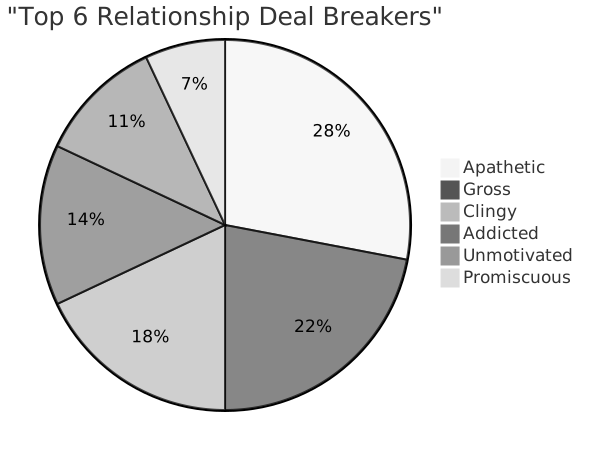
Analysis of 285 participants published in Personality and Individual Differences journal reveals a clear deal breaker hierarchy for women seeking long-term relationships.
The rankings proceed as follows:
#1: Apathetic Behaviour (strongest deal breaker)
- Being inattentive or uncaring
- Demonstrating untrustworthiness
- Dismissing partner’s interests
- Emotional unavailability
#2: Gross Behaviour
- Poor hygiene
- Bad breath
- Unkempt appearance
- Unpleasant body odour
#3: Clingy Behaviour
- Excessive neediness
- Constant contact demands
- Jealousy and possessiveness
- Inability to respect boundaries
#4: Addicted
- Substance dependencies
- Behavioural addictions
- Compulsive patterns
- Inability to maintain commitments
#5: Unmotivated
- Lack of ambition
- Poor career prospects
- Passive approach to life
- No drive for improvement
#6: Promiscuous
- Extensive sexual history
- Currently dating multiple partners
- Patterns of infidelity
- Inability to commit
The Universal Deal Breaker
Hygiene emerges as a universal requirement across all cultures, ages, and relationship contexts.
Research shows:
- 87% of women report being turned off by body odour
- 71% consider unclean appearance an immediate deal breaker
- Bad hygiene ranks as the #1 dating “ick” in 2024 surveys
This finding holds remarkable consistency worldwide, suggesting biological rather than purely cultural origins.
Emotional Intelligence: The Secret Weapon
Here’s something the mainstream dating advice misses…
Emotional intelligence correlates with relationship satisfaction at r = 0.32 - a moderate but highly consistent effect across multiple studies.
But here’s what makes this fascinating…
Women score higher on emotional intelligence measures than men, particularly in:
- Empathy and emotional recognition
- Understanding others’ perspectives
- Reading nonverbal emotional cues
- Providing emotional support
Yet 93% of users on platforms like Hinge prefer emotional vulnerability in partners, suggesting women seek men who can match their emotional intelligence even though men statistically score lower.
This creates a competitive advantage for men who develop emotional intelligence skills. In a dating market where most men underperform on emotional availability, the man who can communicate feelings, demonstrate empathy, and handle conflict constructively stands out dramatically.
What Emotional Intelligence Actually Looks Like
It’s not about being soft or oversensitive. Research identifies four core components:
Self-awareness: Recognising your own emotions and their impact
Self-management: Regulating emotional responses appropriately
Social awareness: Reading others’ emotional states accurately
Relationship management: Navigating interpersonal dynamics effectively
Studies by Daniel Goleman found that in leadership contexts where top performers were examined, gender differences in emotional intelligence washed out completely - the men were as good as the women, the women as good as the men.
The implication for dating? Emotional intelligence represents a learnable skill that creates disproportionate advantages in modern relationship formation.
Generational Shifts Reshape Dating Dynamics
The dating landscape varies dramatically by generation…
Gen Z (Ages 18-27)
Dating app usage: Most digitally native, yet most frustrated
- 81% want marriage and long-term commitment
- 90% express frustration with dating apps
- 27% actively seek “the one”
- 69% prefer phone calls before first dates
Gen Z shows something unexpected… despite being digital natives, they’re returning to traditional courtship patterns like phone conversations and in-person meetings through school or social circles (25%) rather than apps (16%).
Millennials (Ages 28-43)
Dating app dominance:
- 61% of all dating app users are Millennials
- Average 2 hours daily on dating platforms
- Most likely to pay for premium features
- Yet report lower overall relationship satisfaction than Gen Z
Millennials pioneered app-based dating but now face the consequences… a dating market optimised for endless choice that paradoxically makes meaningful connection harder.
Gen X (Ages 44-59)
Experience-based preferences:
- Most likely to know exactly what they want
- 86% of Gen X men prefer partners at least 10 years younger on apps
- 46% of Gen X women open to dating younger men
- Less influenced by social media trends
The generational data reveals that age doesn’t change fundamental preferences for traits like kindness, attractiveness, and intelligence. But it dramatically affects how people approach dating platforms and relationship formation.
Dating Apps Create Artificial Selection Environments
Here’s the uncomfortable truth about modern dating…
Dating apps systematically distort partner selection through design choices that emphasize filterable characteristics like height, age, and income over chemistry, humour, and emotional connection.
The numbers are staggering:
Match rate disparity:
- Average man: 0.87% match rate (1 in 115)
- Average woman: 30.7% match rate
- This creates an 11-fold difference in dating experiences
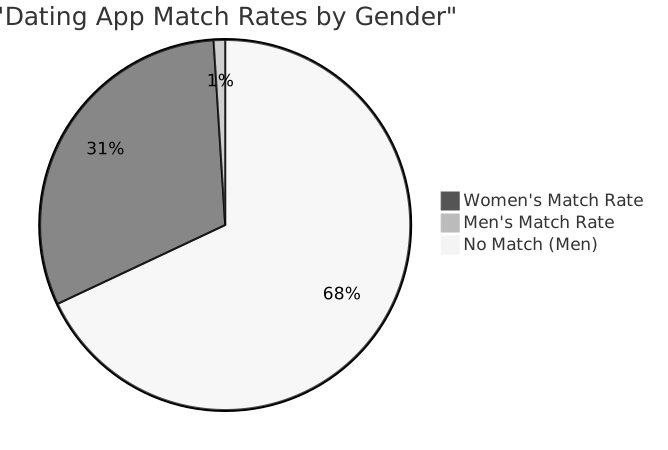
These platforms demonstrate higher inequality than 95.1% of world economies, with the “bottom 80% of men competing for the bottom 22% of women.”
Such extreme disparities influence user behaviour in ways that may not reflect natural attraction patterns.
Why The App Environment Distorts Preferences
Dating apps encourage filtering before chemistry can develop:
- Pre-selection on age, height, income
- Decisions made from static photos
- Bios read after visual assessment
- No access to humour, emotional intelligence, or chemistry
The result? Women apply filters that screen out men they’d be attracted to in person, while men face rejection rates that would never occur in natural social environments.
Research published in 2025 found physical attractiveness improvements yielded 10x greater impact on app success than intelligence improvements, but face-to-face studies show far more balanced preference patterns.
The Personality Paradox
Here’s where relationship science gets really interesting…
Big Five personality research examining thousands of couples found that:
Conscientiousness (r = 0.90) predicts marital satisfaction Agreeableness (r = 0.855) strongly correlates with relationship quality
Extraversion and Openness show weaker, inconsistent effects
But here’s the paradox…
Women don’t consciously prioritise these traits in stated preferences. When asked what they want, they emphasise attractiveness, humour, and intelligence over conscientiousness.
Yet long-term relationship success depends far more on:
- Reliability (conscientiousness)
- Conflict management (agreeableness)
- Emotional regulation (conscientiousness + agreeableness)
This creates another stated-versus-revealed preference gap. Women choose partners based on attraction triggers that don’t predict long-term compatibility, then wonder why relationships fail.
The research implication? Short-term attraction operates differently than long-term compatibility, and women’s conscious awareness of this distinction remains limited.
What This Means for High Performers
If you’re reading this as a high-achieving man focused on self-improvement, here’s your strategic takeaway…
Leverage Your Strengths
Your career success provides advantages in:
- Initial visibility on platforms displaying income
- Lifestyle compatibility with ambitious women
- Long-term stability signals
But don’t rely on accomplishments alone. Women overestimate how much they care about income in stated preferences.
Invest Where It Matters Most
The research suggests prioritising:
Physical presentation (20x impact of intelligence on initial attraction)
- Fitness and body composition (13-14% body fat, moderate muscle)
- Grooming and hygiene (universal requirement)
- Style and presentation (signal conscientiousness)
Humour development (3x dating success rate)
- Improv classes or stand-up workshops
- Social practice in low-stakes environments
- Natural development through diverse experiences
Emotional intelligence (r = 0.32 with relationship satisfaction)
- Therapy or coaching to develop self-awareness
- Active listening skill development
- Conflict management training
Understand Platform Limitations
Dating apps amplify certain preferences (height, age, income) while obscuring others (humour, emotional intelligence, chemistry).
Consider:
- Social circle expansion for organic meetings
- Activity-based social groups (sports, hobbies)
- Professional networking with romantic possibilities
- Speed dating events (recreate blind date dynamics)
These environments allow your personality, humour, and emotional intelligence to create attraction before filterable characteristics screen you out.
Pro Tip: Focus on Revealed Over Stated Preferences
Here’s something that’ll save you years of frustration…
Stop asking women what they want. Start observing what they actually respond to.
This doesn’t mean manipulation or deception. It means recognising that:
- Women genuinely don’t know what drives their attraction
- Social desirability bias influences stated preferences
- Revealed preferences (actual behaviour) predict outcomes
In practical terms:
Don’t obsess over stated preferences like “must be 6 feet tall” or “looking for someone established.” Many women who state these preferences end up with partners who don’t meet them.
Do focus on creating actual attraction through:
- Physical presentation and fitness
- Humour and social intelligence
- Emotional availability and vulnerability
- Demonstrating conscientiousness through actions
The research validates what successful men have always known… attraction isn’t a checklist. It’s a feeling created through interaction, chemistry, and emotional connection.
The Path Forward for Modern Men
The evidence overwhelmingly demonstrates that women’s stated preferences poorly predict their actual partner choices, creating a massive gap between dating advice and reality.
The worldwide study findings validate what many men instinctively felt… mainstream dating advice often contradicts what actually works because it relies on stated rather than revealed preferences.
Your mission isn’t to become what women say they want. It’s to understand what actually creates attraction and invest your improvement efforts accordingly.
Physical fitness matters more than most men want to admit. Humour production creates disproportionate advantages. Emotional intelligence separates high performers from average men. And hygiene remains non-negotiable.
But here’s the most important finding…
The traits that create initial attraction (physical appearance, humour, confidence) differ from traits that predict long-term success (conscientiousness, agreeableness, emotional regulation).
Master both. Use attraction-generating traits to initiate relationships, then leverage compatibility traits to build lasting partnerships.
Your Next Steps
Ready to master modern dating dynamics?
Discover “The Masculine Blueprint” - the comprehensive guide to understanding female attraction psychology and developing the characteristics that create genuine connection.